QHY miniCAM8 Mono Camera Combo
QHY
Couldn't load pickup availability
Share
This camera Is normally shipped to order. Please contact us to confirm current pricing and delivery times.
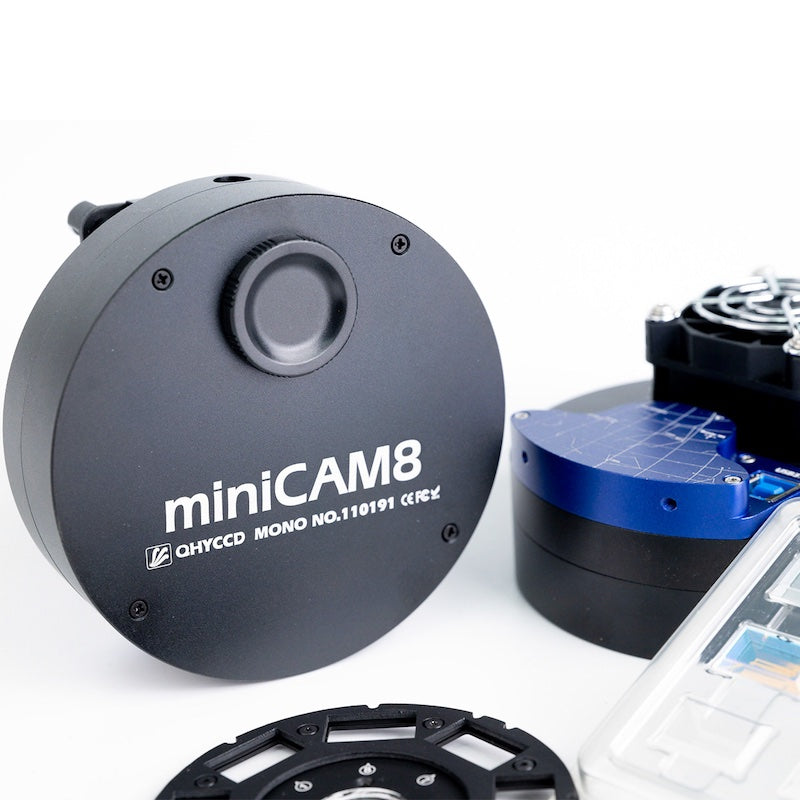
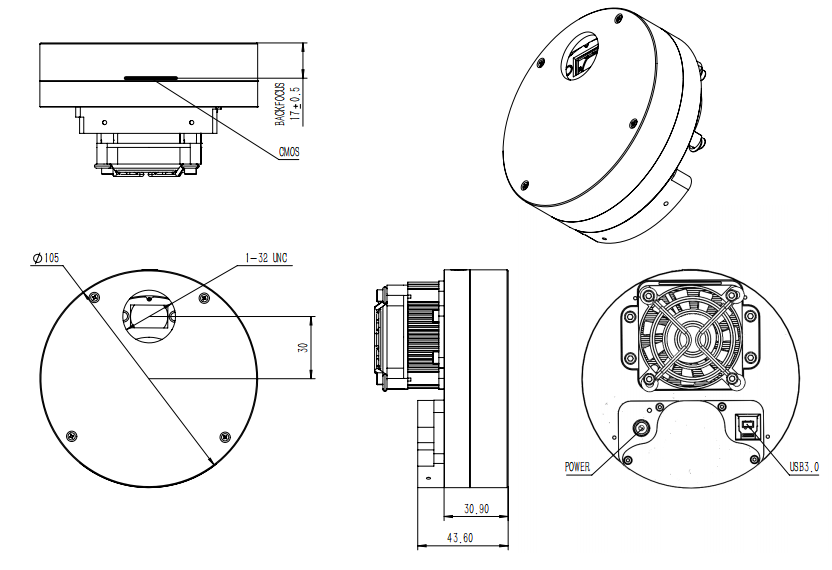
At just over 4 inches in diameter and a few inches thick, the new miniCAM8 is a compact, high resolution, high performance, cooled imaging system capable of exceptional, high-quality deep space images and planetary images.
So often, compactness in astroimaging is achieved at the expense of some other critical feature found in multi-component cooled systems, such sensor quality or thermoelectric cooling, etc. Such is not the case with the new miniCAM8. Based on Sony’s IMX585 8 MP sensor, the miniCAM8 includes full TE cooling capable of reaching a delta of -45℃ from ambient along with a built-in 8-position filter wheel for complete LRGB and narrowband imaging.
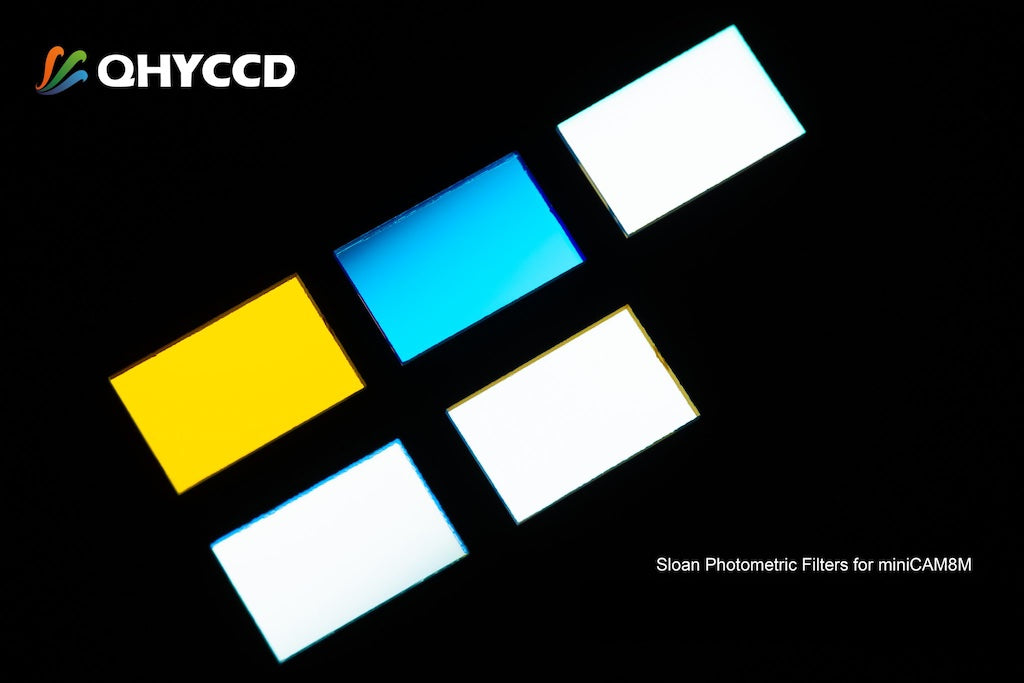
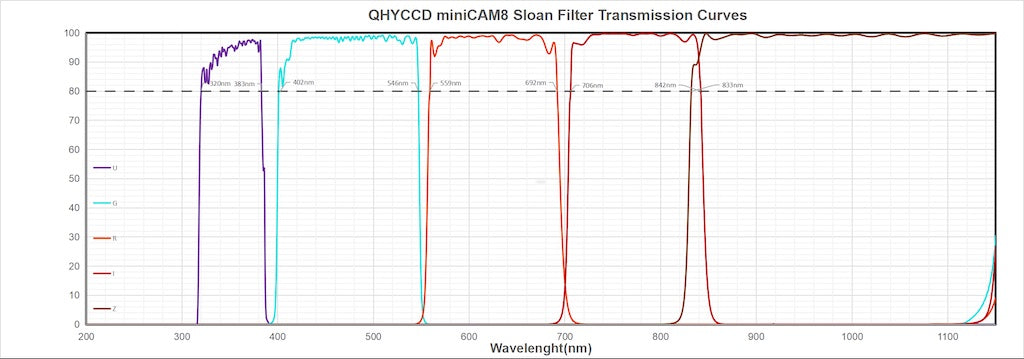
This Combo package includes the Sloan Filter set of 5 filters: u’, g’, r’, i’, z
Features
High Near-Infrared Sensitivity
The IMX585 is a Sony Starvis II processor that enables high sensitivity and high dynamic range (HDR). It also improves sensitivity in the near-infrared range by approximately 1.7 times* compared to the IMX485. The new camera QHY miniCAM8 has a maximum quantum efficiency of 60% in the near-infrared band and 92% in the visible wavelength band.
Back Illuminated
One benefit of the back-illuminated CMOS structure is improved full-well capacity. This is particularly helpful for sensors with small pixels. In a typical front-illuminated sensor, photons from the target entering the photosensitive layer of the sensor must first pass through the metal wiring that is embedded just above the photosensitive layer. The wiring structure reflects some of the photons and reduces the efficiency of the sensor.
In the back-illuminated sensor, the light is allowed to enter the photosensitive surface from the reverse side. In this case, the sensor’s embedded wiring structure is below the photosensitive layer. As a result, more incoming photons strike the photosensitive layer, and more electrons are generated and captured in the pixel well. This ratio of photon to electron production is called quantum efficiency. The higher the quantum efficiency, the more efficient the sensor is at converting photons to electrons, and hence the more sensitive the sensor is to capturing an image of something dim.
Zero Amplify Glow
QHY miniCAM8 is also a zero amplifier glow camera.
Anti-Dew Technology
Based on almost 20-year cooled camera design experience, the QHY cooled camera has implemented the fully dew control solutions. The optic window has a built-in dew heater, and the chamber is protected from internal humidity condensation. An electric heating board for the chamber window can prevent the formation of dew, and the sensor itself is kept dry with our silicon gel tube socket design for control of humidity within the sensor chamber.
Cooling
In addition to dual-stage TE cooling, QHYCCD implements proprietary technology in hardware to control the dark current noise.
Linearity HDR Mode
The native ADC of the IMX585 sensor is 12-bit. Compared to 16-bit, the 12-bit depth offers fewer bits, resulting in a relatively narrower dynamic range, which may lead to issues such as insufficient colour gradation and potential information loss. During the product development of miniCAM8, QHYCCD merged high and low gain to extend the data to 16-bit. However, since this 16-bit depth is not native, a sudden shift in linearity might occur, affecting the smooth transition in images. To address this, QHYCCD developed the “Linearity HDR” mode, which uses an algorithm-based approach to correct image linearity through software, ensuring smoother transitions and richer color representation.

Mono Camera Details
- What's in the Box
- Specifications
What's in the Box
- Camera
- 12V 5A Power Adapter
- Power Cable
- 12V Self-Locking Power Cable
- 1.3m USB3.0 Cable
- 1.25-inch Extension Ring
- Desiccant Tube
- Lens Mounting Clamp
- Screwdriver
- Camera Packaging Bag
- Luminance Filter
- Red Filter
- Green Filter
- Blue Filter
- H-Alpha Filter (7nm)
- OIII Filter (7nm)
- SII Filter (7nm)
Specifications
| Attribute | Details |
|---|---|
| Sensor | Sony IMX585 |
| Sensor Type | Mono |
| BSI/FSI | Back Side Illuminated |
| Sensor Size | 1/1.2 inch |
| Pixel Size | 2.9μm x 2.9μm |
| Total Pixel Area | 3856 x 2180 |
| Effective Pixels | 8 MP |
| Full Well Capacity | 54ke- |
| Readout Noise | 0.76 – 7.8 e- |
| A/D | 12bit (output as 16-bit) |
| Full Frame Rates | 41.5FPS@8bit, 23.5FPS@16bit |
| Exposure Time Range | 11μs-900sec |
| Shutter Type | Electronic Rolling Shutter |
| Cooling System | Dual Stage TEC cooler |
| Weight | 480g |
Let customers speak for us
from 180 reviewsThe 50mm SuperView (Erfle) eyepiece in a long focal length telescope gives a big, wide view of the sky that shorter eyepieces can't do. Coupled with an 8 inch f/12 Cassegrain, it gives a 1.2° field of view. The entire Moon fits easily in the view, as does most of the Pleiades/Matariki and the Orion Nebula.
For contrast, a 32mm Plossl has only about 0.5° field of view in the same telescope.
It's very easy and comfortable to look through, with plenty of eye relief even wearing glasses. Some eyepieces can be really particular with where you need to place your eye, but this isn't one of them.
If I had to pick a fault for it, it's a little lacking in contrast, but considering the price, it's extremely minor.
TL/DR: If you have a long focal length telescope, you should have one of these, and for $140, you don't have an excuse not to.
Weather and work mean I haven't yet had a chance to try out the coma corrector under the stars, but based in my short experiments with viewing tree branches about 150 m distant from my telescope, it looks like this coma corrector is doing a good job at bringing the entire field of view into focus. This is with a 10" F4.7 Newtonian, and with a full frame (35 x 24 mm) camera. Note that this corrector is a rebranded GSO come corrector (I don't think AstroNZ will mind me saying that), and so it does need 70-80mm back focus (so you'll likely need 20 to 30 mm M48 extension rings depending on what you're doing), and despite what the website says, it does also lengthen the scope focal length by a factor of ~ 1.1, so you lose a bit of field of view, but not much.
All in all for the price, I think this is pretty good value, and a great place to start you want to sharpen the stars across the field of view.
I haven't had a chance to try it yet, as it's a present for my son for Christmas, but Andrew was super helpful when buying!
I was purchasing a weight for my ioptron tracker when I saw this tripod and I decided to purchase it as well to give my tracker its own dedicated tripod.being that this one was designed for my to be used on it it was a no brained. I have only used it once so far but it is wonderful and was easy to fit my tracker to. Very satisfied customer
Rechargeable is great. Handy size for pocket, and exceptional pointing in daylight conditions up to 60 odd meters.
Binoculars were easy to set up/focus for my eyesight (wearing glasses). Bundled instructions were easy to follow. Image is crisp and clean when focussing on distant objects(in daytime). Now just need some clear skies so can try them out at night.
A very convenient device for those times when you want to see the sun (or something very bright) and you want to still be able to see afterwards.
Easy to carry as it is small and flat.
Great scope, great accessories, but most importantly the best customer service I've ever seen from any business.
These arrived quickly and were exactly what we needed for seeing the partial solar eclipse! The flat cardboard rectangle ones are great if you wear glasses and find it hard to wear the goggle/glasses shaped ones, these flat ones you just hold up in front of your glasses and they are perfect :)
Arrived within 24 hours (amazing) as we ordered late. I appreciate that they are made to the ISO standard. Thanks!
Appears to be same model as the GSO brand on Aliexpress. Astronz price is same as if not better - shop local. Work fine on my short focus refractor.
Astronz 08" Premium Dobsonian Telescope
Very fast service. This worked wonderfully to view the partial eclipse last Monday morning.